

Leaks & Service Repairs

757-399-3066 ext 3 (Leaks & Service Repairs)

Reroof Estimates & Inspections

757-399-3066 ext 1 (Reroof Estimates & Inspections)

Tag: roofing pavers

Commercial Applications for Walkable Roofing Pavers

Many commercial buildings are designed with flat or low slope roofs which are doing one simple thing: keeping the weather out.

Of course, that’s the most important thing for a roof to do, but it’s not the only thing it can do. And in Hampton Roads’ competitive business environment, using every single square foot available can give a business a real leg up.

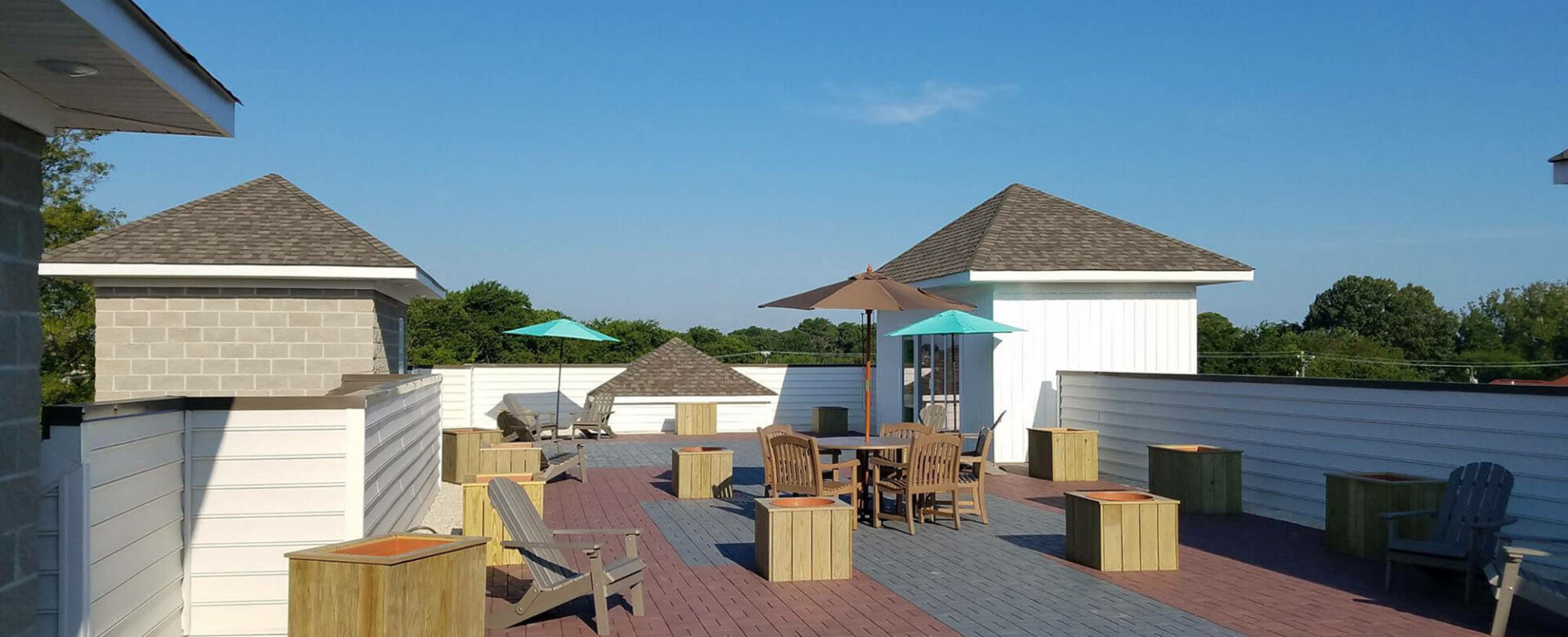
Walkable roofing pavers can give owners of commercial structures a competitive advantage in a variety of ways. The same system that turns a residential flat roof into a rooftop terrace works just as well or better at commercial scale, where the return on that square footage can be measured in additional revenue, higher occupancy, better tenant retention, or simply a stronger competitive position in the market.

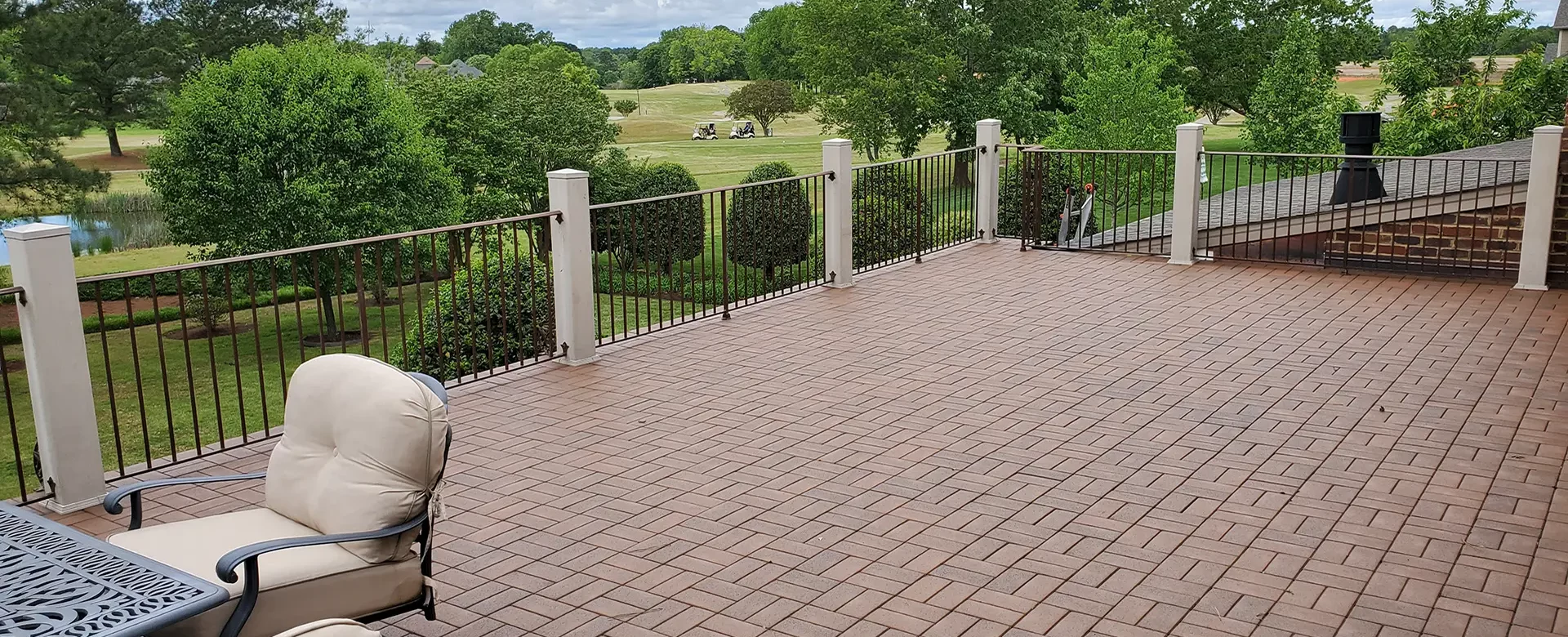
The concept is straightforward: a waterproof TPO membrane goes down first (and is possibly already on a no slope commercial grade roof), followed by a drainage mat, and then durable rubber composite paver squares are set on top. They aren’t permanently adhered, which means individual squares can be lifted, repositioned, or replaced without disturbing the roof below. The result is a stable, attractive, fully walkable surface that protects the roof underneath while turning dead square footage into usable space.

If you want the full technical picture on how the system works, we covered it in an earlier post. Here, we want to talk about what’s possible when commercial property owners start looking up and thinking about their roofs differently.

Restaurants: More Capacity, Same Rent

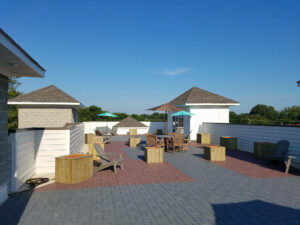
Expanding a restaurant’s seating capacity is one of the hardest and most expensive moves an operator can make, unless you go up rather than out. A rooftop dining terrace adds seats without adding to the lease footprint, – a nearly impossible thing to accomplish any other way.

In Hampton Roads, where spring and fall offer some of the best outdoor dining weather on the East Coast, a rooftop terrace extends the revenue-generating season well beyond the summer months. A rooftop bar creates its own draw for guests who come specifically for the experience of the space, not just the menu. For restaurants looking to differentiate in a crowded market, the rooftop vibe is hard to replicate.

Keep in mind: commercial restaurant installations require attention to load capacity, drainage, safety railings, and permitting, but these are all navigable with the right contractor and a little lead time in the planning process.

Hotels: High End Amenities

For hotels, amenity space goes beyond function and becomes a true marketing asset in a crowded tourist industry like we have in Virginia Beach. A rooftop terrace will show up in photos, reviews and in the mental checklist travelers run through when choosing where to stay. Boutique and mid-scale properties that can’t compete with large resorts on square footage or ocean frontage can use a rooftop installation to punch well above their weight on a unique experience.

This is particularly true for smaller oceanfront and ocean-block hotels in markets like Virginia Beach. A hotel that sits one or two streets back from the water may have limited or no ocean views from its standard rooms or ground-level common areas. A rooftop terrace changes that, providing a legitimate “ocean view” space on the property, which opens up amenity language and marketing that wasn’t available before.

Beyond the view, rooftop spaces can be booked for private events, corporate gatherings, and weddings, providing a revenue stream without a significant increase to overhead.

Multifamily Residential: One More Reason to Renew a Lease

Apartment buildings and condo developments also compete heavily on amenities, and outdoor communal space is consistently near the top of what prospective tenants and buyers want. For urban infill properties or buildings with limited ground-level common space, the roof is often the only place to create meaningful outdoor space.

A rooftop terrace that’s furnished, landscaped, with seating areas or a grill station is a premium amenity that will stand out in listings. It can also increase tenant retention. When tenants value their building’s amenities or see them being invested in, they are more likely to stay put, which is important since turnover is one of the most expensive things a property manager deals with. Walkable composite pavers are especially well-suited for shared amenity spaces because they require almost no ongoing maintenance. You won’t have to worry about resealing, splinters or rotting boards to replace season after season.

Office Buildings: Out(side) of Office

Employee expectations around office environments and personal wellbeing have shifted dramatically in the last several years. With more workers concerned about work/life balance and having a healthy work environment, whether they’re working from home or at an office, outdoor access during the workday has become a baseline requirement for many people. Building owners competing for commercial tenants are responding accordingly.

A rooftop terrace gives office occupants a place to take calls outside, step away from a desk for lunch, or decompress between meetings in a way that a lobby or break room can’t replicate. For building owners, it’s one more amenity to add to your sales pitch that can have a big influence over modern companies’ leasing decisions. Pavers can also be paired with planters and greenery to create green spaces that feel restorative and functional. Happy employees have higher retention, fewer sick days, and are more productive, which is good for everyone.

Rooftop Gardens: Creating Green Space

Walkable pavers are an excellent foundation for rooftop garden installations such as raised garden beds and green zones. The applications are varied: a restaurant with a rooftop herb or produce garden can use this as both a supply source as well as a marketing story for health and environmentally conscious customers. A corporate campus with rooftop green space creates an amenity that supports employee wellbeing. A multifamily property with community garden plots turns the roof into something tenants actively use and value. The pavers provide the durable, low-maintenance foundation that makes it worth a property owner’s while.

What Commercial Installations Require

Regardless of the application, there are some key fundamentals to make walkable pavers work: structural soundness, proper waterproofing, drainage, and experienced installation. Commercial projects typically require additional considerations like load calculations (typically done by a structural engineer), safety and railing code requirements, and local permitting, so the contractor you choose needs to be equipped to handle the full scope.

The long-term investment case is strong, though. Firestone SkyPavers carry a 20-year warranty with a potential lifespan of up to 50 years, compared to wood or other traditional surface materials that require regular maintenance and eventual replacement.

Put Your Roof to Work

The flat roof on a commercial building doesn’t have to just be an expense. With the right installation, it can become a revenue driver, a tenant amenity, a marketing differentiator, or an employee benefit. If you’re curious about what a rooftop installation could look like for your property, we’d love to talk to you about it. Andrews Roofing has commercial roofing experience across Hampton Roads, including complex projects in demanding coastal environments. We know how to assess what’s feasible, navigate the requirements, and provide a long-lasting, high-quality installation. Contact us today.
read more

Designing a Better Deck with Walkable Roofing Pavers

If you have an elevated deck or raised patio, you probably already understand and appreciate the value of an outdoor living space in the Hampton Roads region with our year-round mild weather.

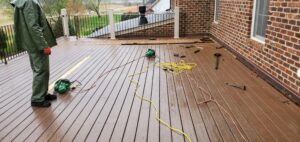
Whether you invested in the deck yourself, or it came with your property when you purchased it, you also probably understand and appreciate how much maintenance and upkeep these decks require. You may be seeing boards that have warped, splintered, or gone gray; a surface that needs sanding and resealing every couple of years; or just an overall look that feels dated and tired. And if you are, you’re probably starting to weigh your options for repairs or replacements.

The obvious choices are what most people gravitate toward: replace the wood with composite decking, re-board the whole thing, do extensive sanding and resealing or put down concrete pavers and call it done. All of those are reasonable paths, but there is another path that you may not have considered that is a great option for elevated decks and raised patios in particular: walkable rubber composite roofing pavers.

These are the same materials used to create rooftop terraces and walkable flat roof surfaces, but it turns out that everything that makes them excellent for a rooftop makes them excellent for a deck, too.

The Usual Suspects

Wood decking is a popular choice because of cost as well as the warmth and aesthetics it brings to a space, but it requires a real maintenance commitment, especially in a coastal environment like Hampton Roads. The humidity, the salt air, the wet, rainy springs and blazing summers can take a toll. Wood warps, splits, splinters, fades, and eventually rots if it isn’t kept up. Pressure washing, sanding, staining, and sealing is a recurring cycle that costs time and money year after year, and inevitably the wood will get to a state where it needs to be fully replaced.

Composite decking was developed largely to solve those problems, and it does address some of them. It won’t rot or splinter, and it requires less maintenance than wood. However, it can get uncomfortably hot underfoot in direct summer sun, which anyone who’s walked barefoot across a composite deck in July in Virginia Beach can attest to. And in rooftop or terrace situations, it isn’t designed to account for drainage, waterproofing, or the specific stresses of a surface that’s also functioning as a protective layer over a structure below. In addition to that, it can become very costly depending on the size of the deck you’re replacing.

Concrete pavers are durable and attractive, but weight becomes a real issue on elevated structures. Concrete is heavy, and a lot of it on an elevated deck puts serious structural stress on the framing, which on an older deck may already be showing wear.

The Unusual Suspect

Walkable rubber composite roofing pavers were engineered specifically for elevated, exposed surfaces, whether that’s a rooftop terrace or an elevated deck. Here are a few “pros” of this material that go beyond the rooftop.

  • They’re dramatically lighter than concrete. Elevate SkyPavers weigh roughly 35% of what comparable concrete pavers would. On an elevated deck, that’s a big difference. Less weight means less structural stress on the framing, which matters both for safety and for the long-term integrity of the structure.
  • Roofing pavers will not warp, splinter, gray out or rot. The material is inherently resistant to moisture, and in a region like Hampton Roads where humidity is a fact of life year-round that is a meaningful advantage.
  • They reflect heat rather than absorbing it. The TPO membrane that underlies the paver system is typically white and highly reflective. This keeps the surface temperature considerably lower than composite decking or concrete in direct sun. On a sunny summer afternoon at the Virginia Beach oceanfront, that makes a big difference for a surface to stay walkable and enjoyable rather than becoming a bed of coals you need to navigate in bare feet.
  • Elevate SkyPavers carry a 20-year warranty and have a potential lifespan of up to 50 years. Compare that to a wood deck that needs significant attention every few years, and the math on long-term cost starts looking very appealing.
  • And importantly, they look good. Walkable pavers are available in a wide range of colors that can be selected to complement your home’s exterior. The finished surface is clean, modern, and attractive.

Roofing Paver Installation

These systems work in layers. First the existing deck surface will need to be evaluated to ensure it’s structurally sound. This step is critical and should be done by a qualified contractor who can tell you whether any framing repairs are needed before any additional weight is added. From there, a TPO waterproofing membrane is installed, followed by a drainage mat, and then the pavers are set on top. The pavers aren’t permanently adhered, which means the surface beneath remains accessible and the system can be adjusted if needed.

The result is a surface that protects the structure below while providing a durable, attractive, walkable surface above – exactly what a good deck surface should do.

As with any roofing or elevated surface project, installation should be handled by a licensed contractor with experience in this specific material. The system has its own requirements and best practices and getting it right matters both for performance and for warranty purposes.

A Good Fit for Hampton Roads

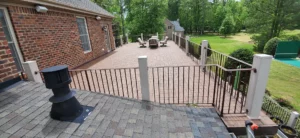
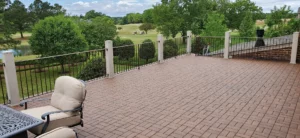
Elevated decks and raised patios are common throughout Hampton Roads: second-floor decks on oceanfront and ocean-block homes, raised patios on homes with grade changes, balconies on multi-story townhomes in Virginia Beach, Norfolk, and Chesapeake. Many of these surfaces were built with wood and are now at or past the point where they need an upgrade.

If you’re already thinking about what to do with an aging deck, it’s worth adding roofing pavers to the conversation before you default to the familiar options. For elevated surfaces especially, the combination of low weight, durability, heat reflectivity, and longevity makes a truly compelling case.

Andrews Roofing has experience with walkable paver installations across Hampton Roads, including in the demanding coastal environments where these materials really prove their worth. If you’d like to talk through whether this approach makes sense for your deck or raised patio, contact us today. We’re happy to take a look at your home’s specific situation and walk you through the options.

read more

Create More Usable Space with Roofing Pavers

Flat roofs often go completely unnoticed when in reality they can be excellent usable space.

In fact, walkable roofing surfaces allow flat roofs and decks to become not just usable, but more energy efficient and sustainable in many cases.

What is a Walkable Roof?
A walkable roof surface must be flat, strong enough to bear the appropriate amount of weight, and must meet the local building codes for safety regarding railings or walls around the exterior of the walkable space. In many cases, industrial buildings have flat roofs that are walkable, but are often just used for maintenance and HVAC access needs. In residential homes, walkable roof surfaces may be porches or balconies as well as flat rooftops. Locally around the Virginia Beach area we also see cupolas, widows’ walks, crows nests, sun decks and more.

What types of materials work for walkable roofs?
For high traffic roofs, composite roofing pavers are a durable and attractive option. Roofing pavers are generally made of rubber, and in many cases they are made almost entirely from recycled materials. This makes them an ecologically friendly option. Their lifespan also makes them a sustainable option, as they can last up to 50 years, further reducing waste.

How do rubber pavers work?
If you’re interested in creating a walkable roof with rubber pavers, it’s critical to use a roofing contractor experienced in this material. They will be able to talk to you about whether or not the roof surface in question is indeed up to code and weight bearing. They will also know how best to lay the foundation for these pavers so that proper drainage is achieved. Generally, a roof consists of wood sheathing which is then covered by a thermoplastic polyolefin (TPO) membrane roofing material, then a roof drain mat and then the pavers are placed on top.

How are rubber pavers eco-friendly?
The TPO material used as the base of most walkable roofs is usually white, which reflects light and heat, making the roofing structure highly efficient. On top of that, the rubber pavers are only 35% the weight of regular concrete pavers, and our brand of choice, Elevate Sky Pavers, are made of 95% recycled tires. These pavers also come in five different colors to match your needs and aesthetic and come with a 20 year warranty. For many businesses and homeowners, walkable roof surfaces with well draining roof pavers are an excellent place to create a rooftop garden. With full sunlight, plants can thrive in this scenario without the concern of weeds or using precious yard space. Not to mention the additional outdoor living space a walkable roof can create.

Can rubber pavers be used for decks and balconies?
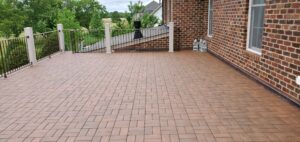
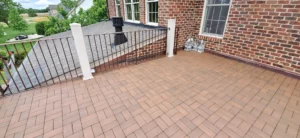
Many of the installations we do with rubber roofing pavers are for second floor balconies and decks. This material is a great option for these areas as they are lighter than other material options such as concrete and are more durable than wood decking. They also reflect heat and are comfortable to walk on. Thanks to the color variations they also look attractive enough to be used in spaces that are directly attached to the exterior of a home.

Who should install walkable roof surfaces?
As with all roofing jobs, walkable rubber roofing pavers should be installed by a qualified and experienced licensed roofing contractor. Do the research to find a company who has experience with this material as its implementation and installation are unique. At Andrews Roofing, we have experience with these specific roofing materials, especially for oceanfront homes and homes looking to take advantage of the beautiful water views in the Hampton Roads area. If you’ve been thinking about making the most of your flat roofing or decking surface, please give us a call. We’d be happy to talk to you more about the feasibility and benefits of these roofing materials.

read more