


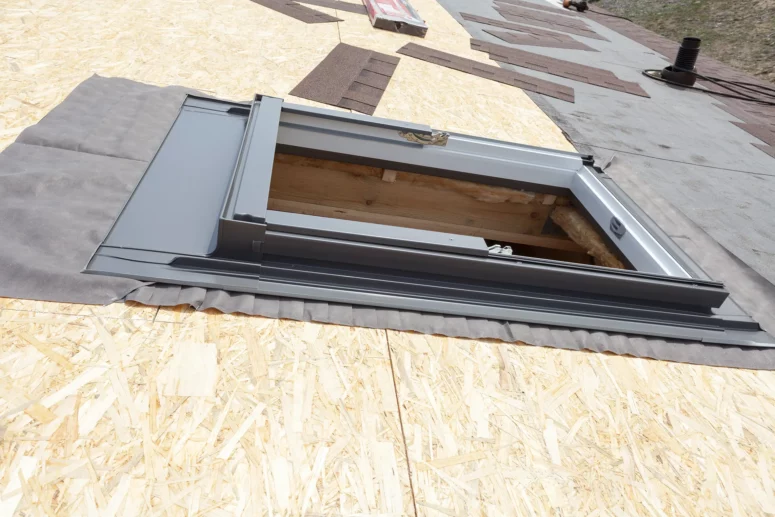
Skylights sometimes have a bad reputation for being a common source of leaks.
While it’s not always fair to point the finger at skylights right away, the reputation isn’t random. A skylight is a hole cut into the one part of your building designed to keep water out, and anything that interrupts a roof surface needs to be installed and maintained carefully. When it is, a skylight can last for decades. When it isn’t, it becomes an easy source of water penetration that can cause loads of damage above and below it.
Remember: Skylights Are Roof Penetrations
The most useful way to think about a skylight is the way a roofer does: it is a penetration, in the same family as a vent, a chimney, or a pipe. Every penetration is a spot where the roofing material has to be cut, and the watertight seal depends on flashing and proper installation rather than on the roof surface itself.
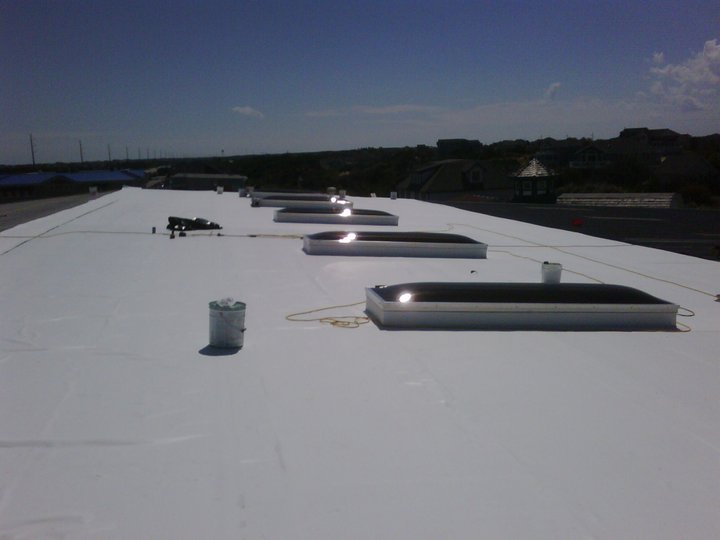
Skylights are used in commercial and residential roofs alike, although in vastly different capacities. A home might have one or two over a kitchen or hallway. A warehouse might have dozens, sometimes 75 or more, to bring in daylight and cut down on lighting costs. Some are there for function, some for looks, and many do both.
Skylights come in a few different styles:
- Flush (deck-mounted) units sit close to the roof surface and are common on homes.
- Curb-mounted units sit on a raised frame built up from the roof deck. These are common on low-slope and commercial roofs, where raising the unit helps keep water from pooling around it.
- Custom-built skylights are made to fit unusual shapes or sizes. Because they are one-off designs, the flashing is often custom as well.
Beyond the mounting style, there are fixed and opening models, multi-panel units, tinted glass, built-in blinds between the panes, and remote-controlled operation. Manufacturers like Velux offer many of these as stock products, along with flashing kits designed to match specific roofing materials.
How Skylights Can Affect Roof Health
A roof is a system. Shingles, membrane, or metal panels shed water across the surface, and the flashing details handle the places where that flow gets interrupted. A skylight is simply one of these interruptions, and each one needs to be installed well and maintained to ensure the system works correctly.
There are three big things to keep an eye out for if your building has skylights:
- They collect water and debris. On the uphill side of a skylight, water has to divert around the unit. Leaves, pine needles, and debris can build up there, keeping moisture and eventually algae or mold against the flashing, which is a familiar problem in tree-heavy neighborhoods across Virginia Beach, Chesapeake, and Suffolk.
- They move differently than the roof. Glass, frames, and flashing expand and contract with temperature swings at different rates than the surrounding roofing. Over years, that movement can loosen seals. This is why maintenance is key.
- They age on a different schedule. A skylight may be installed along with a roof, or years later. Its seals, gaskets, and flashing may reach the end of their useful life earlier or later than the roofing around it.
Common Skylight Problems
 Failed flashing. This is probably the most common issue we see. Flashing can lift, crack, corrode, or separate from the roof surface. If a sealant was used as a shortcut or fix, rather than true flashing, it can dry out and fail quickly.
Broken or cracked glass or glazing. Storm debris, falling limbs, and hail can damage the glass. In a coastal region with regular nor’easters, tropical systems, and regular severe weather, this is a realistic concern. A cracked pane lets water in directly, and it can also compromise the unit’s seal.
Seal failure between panes. In double-pane units, a failed seal can show up as fogging or moisture trapped between the layers. This may be a signal that the unit is aging and ready to be replaced.
Condensation. Humidity is a fact of life in Hampton Roads. Condensation on the inside of a skylight can look like a leak, even when it’s just condensation. But repeated moisture on the frame and surrounding drywall deserves a closer look, because it can also hide a slow leak or indicate some type of insulation or airflow solution is needed.
Mismatched or reused flashing. A flashing kit that doesn’t fit the unit or the roofing material can leave gaps that water will always find. Reusing an old kit during a roof replacement can work in some cases, but only when it is still in good condition and compatible with the new roofing.
Maintaining Your Skylights
You don’t need to climb on the roof to catch most skylight problems early. A few checks from the inside and the ground go a long way:
- Water stains, discoloration, or bubbling paint on the ceiling or the light well around the skylight
- Drips during or after heavy rain, especially wind-driven rain
- Moisture or fogging between glass panes
- Cracks, chips, or gaps in the glass or the frame
- Visible debris piling up around the skylight from the ground, a window above, or a safe vantage point
- Flashing that looks lifted, bent, or rusted
- Dark staining or mildew on nearby ceiling or wall surfaces
It also helps to have the skylights looked at after a major storm and during any routine roof inspection. Skylights are easy to forget about, and small flashing issues are a much easier repair than the interior damage that follows a long-term or major leak.
Repairs around a skylight usually come up in one of four situations: the glass has broken, the flashing has failed, a skylight is being cut in and added to an existing roof, or the skylight is part of a larger roof replacement.
Reroofing Around Skylights
A roof replacement is the best opportunity to get skylights right, since the roofing around them is already coming off. A careful crew will take these steps:
Evaluate the skylight first. Before any new roofing goes down, the crew checks the unit itself: the glazing, the frame, the seals, and the curb if there is one. If the skylight is near the end of its life, a roof replacement is the cost-effective time to swap it, since the access and labor will overlap.
Decide whether to reuse or replace the flashing kit. Depending on the unit and its condition, the existing flashing kit may be reusable. In other cases, a new kit or custom solution is the better choice. Either way, the decision should be based on condition and compatibility with the new roofing material, and not on convenience.
Follow the manufacturer’s specifications. Skylights are installed per the manufacturer’s instructions, and that matters for both performance and warranty. For example, Velux publishes specific flashing requirements for different roof types, and following them keeps the installation sound and warranty intact.
Integrate the flashing with the new roof. Flashing is layered with the roofing to efficiently move water away from penetrations. On low-slope commercial roofs, curbs are flashed into the membrane with details designed for that material.
Check the curb or framing. On curb-mounted units, a solid, properly built curb is part of what keeps the installation watertight. Damaged or deteriorated curbs get repaired before the new roofing is tied in.
Adding a New Skylight
Installing a skylight on an existing roof means cutting an opening in the deck, framing it properly, setting the unit, and flashing it into the surrounding roofing. It is a more involved job than it seems from the inside, which is why placement and planning matter. Roof pitch, rafter or truss layout, and the type of roofing material all affect what style and flashing approach will work. A contractor may take the lead on a project like this, but a roofing specialist will likely need to be involved at some point as well.
Andrews Roofing Can Help
Skylights bring in loads of natural light, and with the right installation and a little attention, they can do it for a long time without causing problems. When installed and maintained well, they can be a major design highlight or energy efficient winner.
But, if you have a skylight that is leaking or showing signs of age, or if you plan to replace your roof that has existing skylights, the team at Andrews Roofing is experienced and well versed in products, installation and what works best for our Coastal Virginia climate. Contact Andrews Roofing today to get started.